AI is playing an increasingly important role in improving field operations
Full Gauge Controls, a pioneering enterprise developing technologies in control and automation, was the first to embrace AI in product development.

Controls, sensors, and automation are no longer differentiators, and become basic requirements driven by data centers, smart buildings, and the digitalization of the HVAC-R industry.
The global market for controllers, sensors, and automation systems applied to HVAC-R systems is expected to surpass USD 30 billion by 2027. According to market studies conducted by Kings Research and consulting firms specializing in building automation, the global HVAC-R controls, sensors, and automation segments (part of a broader market that already exceeds USD 90 billion in building automation systems) is projected to experience strong growth, driven by smart sensors, IoT, and integrated automation.
This growth is no coincidence. It is directly linked to the expansion of data centers, agritech, smart buildings, and highly automated industrial facilities, areas that are rapidly growing in Brazil and around the world.
In practice, climatization and refrigeration systems are no longer an isolated collection of electromechanical equipment but have become a part of an integrated digital ecosystem. Temperature, humidity, pressure, CO2, flow, and occupancy sensors feed programmable controllers, cloud platforms, and Building Management Systems (BMS), allowing for real-time adjustments, reduced power consumption, and greater operational reliability.
In this context, a new HVAC-R technician profile is emerging. While a strong foundation in mechanics, electricity, and refrigeration was once sufficient, it is no longer enough today. The modern technician must understand, at least at a basic level, IT concepts, networking, communication protocols (such as ModBus, BACnet), and the Internet of Things (IoT). This does not mean turning technicians into programmers, but rather training them to interpret data, configure controllers, integrate systems, and diagnose failures that are not always physical, but often logical or communication-related. For example, an incorrectly addressed sensor or a network failure can compromise the performance of the entire system. This change elevated the profession. Technicians are no longer merely corrective maintenance providers, they become performance, power efficiency, and reliability specialists.
One of the most sensitive aspects of this transformation is professional training. The question the market is beginning to ask is straightforward: are technical schools, professional training courses, and industry organizations keeping pace with this evolution? There is still a significant gap. According to ASHRAE (The American Society of Heating, Refrigerating, and Air Conditioning Engineers,) the industry faces a skill gap because the technical training often fails to keep up with the technological progress and the demand for new knowledge, especially in automation, IoT, and power efficiency. This disconnection between education and the market’s demands is one of the factors that contributes to the lack of qualified professionals in HVAC-R. Many courses are still focused almost exclusively on traditional installation and maintenance, while the market demands professionals that are capable of dealing with automation, smart sensors, and connected systems. This creates a mismatch between the supply and demand for qualified labor.
“With the rising demand for more efficient HVAC-R systems, reduced carbon footprints, and improved indoor air quality, the adoption of digital resources, embedded electronics, cloud and IoT-based control has also increased, transforming the profile of the HVAC-R technician. Professional performance now depends not only on mechanical knowledge, but also on skills related to electronics, instrumentation, networks, and data analysis. Thus, today’s technician must incorporate the ability to interpret electrical and logical signals, understand automation systems that automatically adjust operations, and use digital tools and remote diagnostics software,” explains Ronald Borduni, president of DN Automação e Elétrica from ABRAVA.
“With the digitalization of HVAC-R, basic IT knowledge has become indispensable, including networking concepts, information security, IoT, sensors, and data interpretation in monitoring software. Although some technical schools have already incorporated these topics, the pace of technological evolution requires continuous training to keep professionals up to date,” he adds.
On the other hand, this gap also represents a significant opportunity. Professionals who seek additional training in automation, controls, and connectivity tend to position themselves more competitively, avoid competing solely on price, and gain access to higher-value contracts.
“New technologies are constantly entering the market, and professionals must adapt as new demands emerge. In that context, a culture of technical training within companies becomes increasingly important. This has been a core principle at Full Gauge Controls since our early years and is one of the attributes that has made us globally recognized. Artificial Intelligence, in particular, has been gaining ground and is playing an increasingly important role in improving field operations. One example is the development, in partnership with Climtek, a Canadian company, of the HVAC-R’s industry first AI-based technical support platform, trained using or entire technical knowledge base. In addition, some companies in the industry already use AI algorithms to analyze data through APIs, identify consumption patterns, predict abnormal behavior, and adjust control strategies. This type of applications generates real gains in power efficiency, reduces downtime, and increases monitoring accuracy in cold rooms and refrigeration systems, directly impacting both the role and qualifications required of professionals in the field,” says Antonio Gobbi, CEO of Full Gauge Controls.
According to him, it is essential that companies, technical schools, and industry associations continuously monitor for new market trends, and invest in professional development. “Today, technology makes this process much faster and more accessible than it was a few years ago. Digital platforms, such as technical content on YouTube, online learning courses, and the growing availability of specialized technical education, contribute significantly to the training of new professionals and the continuous development of those already in the industry.”
Institutions such as SENAI, a benchmark in technical and professional education in Brazil, play a central role in training refrigeration and climatization technicians, with solid courses focused on installation, maintenance, applied electricity, and the fundamentals of refrigeration systems. However, as HVAC evolves toward an increasingly digital and connected model, the industry itself has begun to discuss the limitations of these traditional curricula. The incorporation of contents linked to automation, smart sensors, communication protocols, building management system integrations, and basic IoT concepts still happen gradually and unevenly. This mismatch creates a gap between the training being offered and the real requirements of modern applications, such as data centers, smart buildings, and automated industries, requiring many professionals to search for additional training in the market in order to keep up with the technological transformation of HVAC-R.
Specialized technical schools also offer traditional training in refrigeration and climatization, but the industry recognizes the need to broaden the focus toward smart connected systems. According to an ASHRAE study, in this new scenario, digital training is no longer a differentiator, and it becomes a true passport to higher-value opportunities in HVAC-R. Professionals who master automation, smart sensors, basic data analysis, and systems integration can access niches that are less price-sensitive and more reliability-oriented, such as data centers, smart building, process industries, and high-performance agribusiness. In addition to expanding the scope of work, this training enables professionals to offer ongoing services such as remote monitoring, predictive maintenance, and performance-based contracts, creating new revenue streams and long-term relationships with clients.
“Most technical schools seek to introduce new technologies to students. However, this process takes place without abandoning the teaching of basic refrigeration, which still represents the majority of installations currently in operation. This foundation remains essential for professionals to correctly understand how systems work before moving on to more technological applications. In fact, the progress of smart HVAC-R is not a passing trend, but a path of no return. Controls, sensors, and automation are no longer optional, they become an essential part of the system. For the industry, that means more efficiency, sustainability, and reliability. For the professional, it means technical evolution, recognition, and new horizons of work. Those who understand this change and prepare now will be one step ahead in an increasingly technological and strategic market,” comments the CEO of Full Gauge.
He also adds that basic network topology knowledge is essential, as well as familiarity with the technical standards that regulate best practices for installation and data communication. These concepts ensure greater reliability, stability, and performance of HVAC-R automation systems.
“For this reason, we always emphasize the importance of having RS-485 communication infrastructure designed and installed by qualified technicians, strictly following technical standards and recommendations. A properly sized and correctly installed network is crucial for the system’s proper operation and for the quality of the data collected. The main players in the market have consolidated networks of qualified installers who are able to serve companies interested in smart HVAC solutions. Therefore, it is not exactly a lack of professionals, but rather the need to know where to find this specialized workforce with the experience in the latest technologies,” says Gobbi.
Borduni also adds that the industry continues to expand, driven by the demand for smart systems, but the lack of qualified professionals may still slow this growth, as occurred with chillers using magnetic bearing compressors, which took longer to become established in Brazil due to the perception of a technical shortage. “To avoid that kind of bottleneck, the industry needs to accelerate training through the updating and expansion of training courses, short-term training programs, partnerships between manufacturers, associations, and schools, as well as incentives for training in automation and IoT, ensuring a workforce prepared to operate increasingly efficient and complex technologies,” he concludes.

Full Gauge Controls, a pioneering enterprise developing technologies in control and automation, was the first to embrace AI in product development.
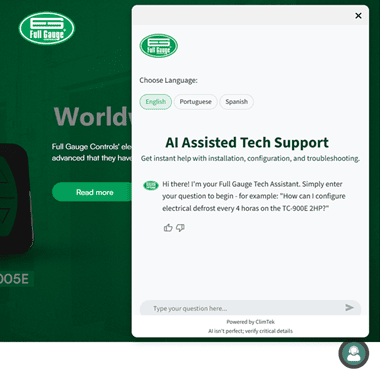
New multimedia AI assistant delivers seamless conversations, video tutorials, and wiring diagrams, now embedded on Full Gauge websites and upcoming FG Finder app

As AI – Artificial Intelligence and IoT – continue evolving, the HVAC-R industry benefits from more integrated and advanced solutions.