Full Gauge Controls, a pioneering enterprise developing technologies in control and automation, was the first to embrace Artificial Intelligence in product development and took the lead, through a partnership with Canada’s Climtek, in AI-based technical support with the creation of a platform for the HVAC-R industry. Speaking about this subject is Antonio Gobbi, founder and CEO of the company.
Abrava + Climatização & Refrigeração: In your opinion, how will the use of Artificial Intelligence impact the manufacturing and availability of control and automation equipment and systems in HVAC-R?
Antonio Gobbi: Artificial Intelligence is already beginning to transform how HVAC-E equipment and systems are designed, manufactured and made available to the market. Today, several manufacturers use AI to optimize product development by simulating operating scenarios, predicting failures, and applying improvements according to requirements defined by engineers. AI has also been applied to improve equipment performance and precision based on variations in thermal load, occupancy, or environmental conditions.
This movement is not exclusive to the refrigeration and air-conditioning sector, but it finds fertile ground in it: HVAC-R systems operate continuously, generate large volumes of data, and promote energy efficiency. Therefore, the trend is for AI to become increasingly present throughout the entire cycle; from prototyping to remote management, driving automation, efficiency, and reliability.
A+CR: How can manufacturers use AI tools to optimize the use of their equipment, systems, and components in the field?
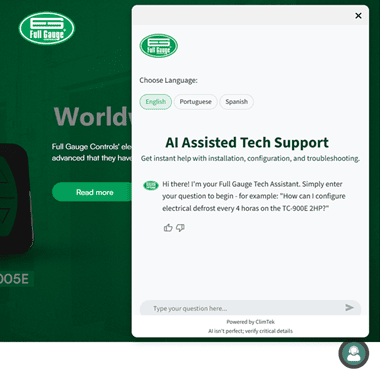
Antonio Gobbi: AI plays a growing role in improving field operations. In the case of Full Gauge Controls, we developed, in partnership with Cimtek in Canada, the HVAC-R industry’s first AI-based technical support platform, trained with Full Gauge Controls’ entire technical library. The tools is integrated into our website and the new version of the FG Finder app, providing specialized support 24 hours a day, capable of answering complex questions about our controllers and about Sitrad.
In addition, some companies in the industry already use AI algorithms to analyze data provided by Sitrad via API, identifying consumption patterns, predicting abnormal behavior, and adjusting control strategies to improve facility performance. This enables real gains in energy efficiency, reduced downtime, and greater accuracy in monitoring cold rooms and refrigeration systems, for example.
A+CR: Which AI tools has your company been using, and what results do they bring to customers?
Antonio Gobbi: Internally, Full Gauge Controls uses AI tools integrated into the Microsoft ecosystem, such as Microsoft Copilot, aimed at increasing productivity in administrative routines. Although this use does not directly impact the end customer, it optimizes internal processes, contributing to faster responses, improved documentation, and greater operational efficiency.
For customers, the most significant impact comes from AI-based technical support available through our website and the FG Finder app. Because it has been trained directly on Full Gauge’s technical database, the system provides precise, fast responses available 24/7, an important advantage for field technicians, who often need immediate support for decision-making. This feature reduces diagnostic time, increases facility safety, and improves the use of our equipment and Sitrad.
A+CR: How do these tools contribute to food safety in the transport and storage of products?
Antonio Gobbi: Artificial Intelligence tools have proven decisive in improving the performance and reliability of air-conditioning and refrigeration facilities. Regarding food safety, AI contributed by interpreting, in real time, the data collected by controllers and by platforms such as Sitrad. This makes it possible to detect temperature deviations or patterns that indicate risk of losses in the cold chain, both in transport and storage. Early alerts and automatic adjustments minimize waste, ensure product integrity, and facilitate audits and traceability.
A+CR: How can they contribute to more energy-efficient systems?
Antonio Gobbi: These same technologies also drive energy efficiency in HVAC-R systems. AI can identify abnormal behavior, optimize defrost cycles, adjust compressors, fans, and electronic expansion valves according to real thermal loads, and predict ideal times for preventive maintenance. As a result, energy consumption is reduced without compromising performance, equipment lifespan is extended, and associated emissions are reduced.
A+CR: To what extent can these tools improve the effectiveness of control and automation in central air-conditioning and refrigeration systems?
Antonio Gobbi: By incorporating predictive analysis and automatic recommendations, AI tools significantly increase the effectiveness of control and automation in central air-conditioning and refrigeration systems. They improve integration between sensors, actuators, and controllers, enabling faster and more precise response to operating variations. The result is a more stable, safe, and intelligent system, with data-driven decision-making and less dependence on human intervention.